Metaversalize
Abstract
The integration of Artificial Intelligence (AI) in French language education has transformed traditional pedagogical approaches, offering innovative tools for personalized and adaptive learning. However, the use of AI in teaching of Français Langue Etrangère ( FLE ) presents significant ethical and pedagogical challenges. This study aims to explore the implications of AI - driven language learning tools in the Indian educational context, focusing on ethical concerns such as data privacy, algorithmic bias and the role of human teachers, as well as pedagogica l issues like student engagement, accuracy in language assessment and cultural contextualization. The study adopts a mixed - methods approach, combining qualitative analysis through interviews with French language educators and AI experts, along with quantit ative surveys conducted among students using AI - assisted learning platforms. The study examines the effectiveness of AI tools in enhancing linguistic proficiency while assessing their limitat ions in achieving communicative competence and cultural awareness ,W DOVR LQYHVWLJDWHV WHDFKHUV· SHUFHSWLRQV RI $,·V LPSDFW RQ traditional classroom instruction and their readiness to integrate AI - based methodologies. AI enhances accessibility and individualized learning, it cannot replace human intuition in language t eaching, particularly in areas requiring nuanced cultural understanding and emotional intelligence. Ethical concerns regarding data security and the risk of over - reliance on AI - based feedback mechanisms also emerge as key challenges. The study suggests a b alanced AI - human teaching model where AI serves as a supplementary tool rather than a replacement for educators. This study contributes to the ongoing discourse on AI in foreig n language education by offering insights into the Indian context, providing rec ommendations for ethical AI deployment and emphasizing the need for teacher training programs to ensure effective AI integration .
Keywords:
Français langue etrangère , Ethics, Pedagogy .
1 Introduction
Artificial Intelligence (AI) is reshaping language education, offering tools for pronunciation correction, grammar improvement and real - time feedback [1] , [2] . In the context of French instruction, AI - powered applications such as chatbots, virtual tutors and adaptive learning systems are gaining popularity [3] . However , their implementation raises ethical and pedagogical concerns. The use of AI in language education has seen a Corresponding Author: piyushfrench96@gmail.com https://doi.org/10.22105/metaverse.v1i2.75 Licensee System Analytics . This article is an open access article distributed under the terms and conditions of the Creative Commons Attribution (CC BY) license (http://creativecommons.org/licenses/by/4.0).
Eth dramatic rise in recent years, driven by technological advancements and the increasing demand for foreign language proficiency. AI - driven tools such as automated assessment systems, intelligent tutoring systems and machine learning - based pronunciation aids are transforming how learners interact with the French language. These innovations promise efficiency, personalization and accessibility, yet they also introduce complex ethical and pedagogical dilemmas. One of the primary ethical concerns surrounding AI in education is data privacy [4] , [5] . AI - based applications collect vast amounts of user data, raising questions about security, ownership and consent. Given the sensitive nature of language learning, where learners may disclose personal information through spoken and written communication, ensu ring data protection is critical. Furthermore, algorithmic bias remains a significant issue. AI models are trained on extensive datasets that may not always represent the diverse linguistic backgrounds of learners, potentially leading to discriminatory outcomes and inaccuracies in assessment. From a pedagogical perspective, while AI can enhance personalized learning experiences, it also challenges traditional teaching methodologies. The automation of certain aspects of language instruction, such as gram mar correction and vocabulary drills, may reduce the necessity for human interaction. However, language learning is inherently social and cultural. AI struggles to replicate the nuances of human communication, including tone, context and cultural subtletie s, which are essential for achieving fluency in French. Additionally, the role of educators is evolving with the rise of AI - driven learning systems.
Teachers must now integrate AI tools into their curricula while maintaining pedagogical effectiveness. This shift necessitates new training programs to equip educators with the skills to manage AI - assisted instruction effectively. The challenge lies in striking a balance between leveraging AI for efficiency while preserving the irreplaceable elements of human instruction, such as motivation, empathy and contextual understanding. The accessibility and equity in AI - driven education ar e pressing concerns. While AI has the potential to democratize education by making high - quality learning resources available to a broader audience, disparities in technological access may intensify existing inequalities. In India, where educational institu tions vary widely in terms of resources and infrastructure, implementing AI in French instruction requires careful consideration of these disparities.
The study aims to: I. Identify the ethical challenges associated with AI in French teaching and learnig, including data security and bias. II. Examine the pedagogical implications of AI on language acquisition, teacher roles and cultural context. III. (YDOXDWHVWXGHQWV·DQGWHDFKHUV·SHUFHSWLRQVRI$, - driven language learning. IV. Recommend strategies for integrating AI ethically and effectively in French language education.
2 Literature Review
The use of AI in French language education has gained significant attention among scholars and educators. Various studies explore its advantages in enhancing personalized learning, efficiency and accessibility. However, concerns persist regarding ethical implications, pedagogical challenges and the changing role of educators in language learning, particularly in teaching French, focusing on its ethical concerns, pedagogical shifts and technological limitations, with a special emphasis on the Indian context.
The application of AI in education is grounded in constructivist and behaviourist theories. Constructivist approaches emphasize learner autonomy and interaction with AI - driven tools that provide customized feedback and adaptive learning paths [6] . In contrast, behaviourist models focus on repetition - based learning facilitated by AI applications such as Duolingo and Babbel [7] . While AI enables scaffolded learning experiences, its effectiveness in promoting communicative competence remains debatable.
The s tud y highlight s $,·VSRWHQWLDO to ease pronunciation correction, automated assessments and real - time feedback, enabling personalized [8] . AI - driven platforms, such as Rosetta Stone and Busuu, employ speech recognition to refine pronunciation, enhancing oral proficiency. The scholars argue that AI struggles with cultural and contextual nuances essential for achieving fluency in French [9] .
Additionally, concerns persist regarding student Chaubey | Metaverse . 1 ( 2 ) ( 202 4 ) 81 - 90 engagement, as AI lacks the dynamic interaction found in traditional classroom settings [10] . In India, the adoption of AI - assisted learning for French remains limited but growing, particularly in urban centres where access to digital resources is higher. Schools and universities offering French courses have begun incorporating AI tools into their curriculum, but the lack of standardized AI - based learning frameworks poses a challenge. Furthermore, the majority of AI - driven language learning platforms are designed for native English speakers, often neglecting linguistic challenges faced by Indian l earners, such as phonetic differences and the influence of regional languages on pronunciation and syntax.
One of the primary ethical concerns in AI - driven language education is data privacy. AI - powered platforms collect vast amounts of user data, including speech patterns and learning preferences [11] . The absence of stringent data protection laws in some regions, particularly in India, raises concerns about unauthorized data usage and potential privacy breaches [12] :LWK,QGLD·V Personal Data Protection Bill still under discussion, many AI - based EdTech platforms operate without clear regulations, making student data security a pressing issue. Algorithmic bias is another concern, as most AI models are trained on datasets primarily comprising native speakers from Western contexts. Studies suggest that AI - based pronunciation tools frequently misinterpret non - Western accents, which can disadvantage Indian learners of French [13] . The voice recognition technologies embedded in AI applications often struggle with Indian English and regional linguistic influences, leading to inaccurate assessments and feedback [14] . The increasing reliance on AI tools raises questions about the role of human educators in language instruction.
The s tud y suggest s that AI should complement rather than replace teachers [15] . AI can assist in routine assessments, grammar correction and vocabulary building, allowing teachers to focus on developing cultural and communicative competence. The educators require new training programs to integrate AI effectively into language curricula. Res earch highlights the need for teacher involvement in AI - assisted learning to maintain emotional support and flexibility [16] . In India, teacher training on AI integration remains minimal. A study by Banerjee and Rakshit [17] found that only 15% of Indian language educators feel confident using AI tools in their classrooms. Many teachers express concerns about being replaced by AI - driven instruction, highlighting the necessity of government - led AI literacy programs for educators. Th e lack of institutional guidelines on AI use in foreign language teaching further intensifies this issue.
French, like many languages, contains cultural and contextual intricacies that AI struggles to capture. AI - driven language models often rely on standardized datasets, lacking exposure to regional variations, slang and colloquialisms. The s tud y indicate s that AI fails to provide adequate cultural immersion, a critical component in language acquisition [18] . Traditional language learning approaches emphasize cultural context, which AI - based tools currently struggle to replicate effectively. For Indian learners, exposure to authentic French culture is crucial but often limited to textbook - based learning. AI tools designed for Western learners may not incorporate the cross - cultural differences necessary for Indian students to grasp French linguistic structures HIIHFWLYHO\ 7KH $,·V LQDELOLW\ WR DFFRXQW IRU WKH VRFLR - cultural background of Indian learners means that language exercises may not align with their cognitive and contextual learning needs. Research suggests that AI can bridge gaps in language education by providing learners with access to native French pronunciation and grammar assistance [3] . The disparities in technological infrastructure and digital literacy hinder widespread AI implementation. While metropolitan areas like Delhi, Mumbai, Chennai and Bangalore witness increased AI adoption in language learning, rural and semi - urban institutions face technological constraints, OLPLWLQJ$,·VUHDFK7KHFRQFHUQVDERXWRYHU - dependency on AI at the expense of classroom - based learning highlight the need for a balanced approach. Many Indian educational institutions still emphasize traditional rote - learning techniques, making the transition to AI - assisted pedagogy challenging. Government policies promoting AI integration in education, such as the National Education Policy (NEP) 2020, advocate for AI - based learning solutions, but their implementation in language education remains emerging [19] .
3 Methodology
This study employs a mixed - methods research approach, combining both qualitative and quantitative methods to gain a comprehensive understanding of the ethical and pedagogical challenges of AI in teaching Eth )UHQFKLQ,QGLD7KHVWXG\IROORZVDGHVFULSWLYHDQGH[SORUDWRU\UHVHDUFKGHVLJQWRDVVHVVHGXFDWRUV·DQG OHDUQHUV·SHUVSHFWLYHVRQ$,LQ)UHQFKODQJXDJHHGXFDWLRQ,WDOVRH[DPLQHVHWKLFDOFRQFHUQVVXFKDVGDWD SULYDF\DOJRULWKPLFELDVDQG$,·VSHGDJRJLF al limitations.
Surveys: Structured questionnaires were distributed among French language students (n=100) and language educators (n=30) from schools, universities and private language institutes across India. The surveys assessed perceptions of AI tools, challenges faced and ethical concerns related to AI in language learning. Interviews: Semi - structured interviews were conducted with 10 French language teachers and 5 AI education experts to gain deeper insights into the pedagogical and ethical challenges of AI integration in Indian French language classrooms.
Focus Groups: Two focus groups (one of students and one of teachers) were held to discuss their experiences and expectations from AI - driven language learning platforms. A literature review was conducted using academic journals, books and government reports on AI in education, ethics and French teaching and learning. 3ROLF\GRFXPHQWVVXFKDVWKH1(3ZHUHDQDO\]HGWRXQGHUVWDQGWKH,QGLDQJRYHUQPHQW·VVWDQFHRQ AI in education.
A purposive sampling method was used to select participants who had prior exposure to AI - based language learning tools like Duolingo, Rosetta Stone, Chatbots and Virtual Tutors. Students: Selected from Indian universities and private institutes offering French courses. Teachers: French educators from schools, colleges and language academies using or considering AI - based teaching methods. AI Experts: Professionals from EdTech firms like byteXL, Codegyan etc. and AI research institutions specializing in AI - assisted language learning.
4 Ethical Challenges
The integration of AI in teaching and learning of French language introduces several ethical concerns that educators and institutions must address. These challenges include data privacy and security, algorithmic bias, the digital divide, teacher replacemen t fears and the dehumanization of learning. This section explores these ethical dilemmas in the context of French language education, particularly in Indian perspective. One of the most pressing ethical issues in AI - driven education is the collection, stor age and usage of learner data. AI - powered platforms collect vast amounts of user data, including speech recordings, learning patterns, personal preferences and assessment scores. The absence of robust data protection laws in many countries, including India , raises concerns about how this data is handled. AI - powered platforms like Duolingo, Rosetta Stone and Busuu store extensive user data, but who owns this data, how it is shared and whether it is monetized remain unclear. In India, the Personal Data Protec tion Bill (PDPB), which aims to regulate data security, has yet to be fully implemented. This legal gap leaves student data vulnerable to exploitation. Concerns about data breaches and unauthorized third - party access make learners hesitant to engage with A I - driven platforms.
To address these issues, educational institutions and AI developers must ensure transparent data policies, informed consent and compliance with data protection regulations. AI algorithms are trained on datasets that predominantly reflect Western linguistic patterns and accents, leading to biases against non - native speakers. This prejudice is especially problematic for Indian learners of French, whose accents and speech patter ns may not align with the training data used by AI - driven pronunciation and grammar tools. AI speech recognition systems often struggle with Indian English influences when learners speak French, leading to incorrect feedback and unfair assessments. Languag e - learning AI tools tend to prioritize standard Parisian French, ignoring regional variations like Québécois French, Belgian French, or African French, which could be relevant for certain learners. Algorithmic decision - Chaubey | Metaverse .
1 ( 2 ) ( 202 4 ) 81 - 90 making in adaptive learning systems may favour some learners over others based on biased data inputs, reinforcing inequalities in language learning outcomes. Addressing this predisposition requires diversifying training datasets and incorporating varied li nguistic and cultural contexts to make AI - driven language learning more inclusive. AI - based French education relies heavily on high - speed internet, advanced devices and digital literacy, which are not equally accessible to all learners in India. Urban vs. Rural Divide: While students in Delhi, Mumbai, Chennai and Bangalore have better ac cess to AI - assisted education, learners in rural and semi - urban areas struggle with limited internet connectivity and outdated technology. Socioeconomic Barriers: AI - powered premium learning apps and virtual tutors come with subscription fees, making them inaccessible to students from lower - income backgrounds. Language Barriers: Many AI - powered French learning tools are designed for English - speaking learners, creating an additional challenge for Indian students who may be more comfortable with Hindi, Tamil, Telugu, Bengali, or other regional languages. To link this gap, the educational institutions must invest in digital infrastructure, provide subsidies for AI - based learning tools and ensure AI platforms are designed to accommodate diverse linguistic backgr ounds.
The automation of language instruction raises concerns about the future role of human educators. AI - driven platforms can now offer automated grammar corrections, personalized lesson plans and real - time feedback, which could potentially reduce the demand fo r language teachers. Some educators fear that institutions might prioritize AI - driven learning systems over hiring qualified teachers to cut costs. In India, where foreign language education is already a niche field, the rise of AI could further limit care er opportunities for trained French educators. However, research suggests that AI should be used as a complement, not a replacement, for teachers. AI lacks the emotional intelligence, cultural awareness and real - world conversational skills that human educa tors provide. To mitigate these concerns, educational policies should promote a hybrid learning model, where AI assists teachers rather than replacing them. The teacher training programs must include AI literacy to help educators integrate AI tools effecti vely. Language learning is deeply human - centred, involving cultural exchange, emotions and real - time interaction, which AI cannot fully replicate. Over - reliance on AI tools may lead to: Reduced Social Interaction: AI - based learning limits face - to - face comm unication, which is crucial for mastering pronunciation, tone and conversational skills. Lack of Cultural Context: French is not just about grammar and vocabulary; it encompasses history, traditions and cultural references that AI struggles to convey meani ngfully. Ethical Dilemmas in AI - Generated Content: AI - generated translations and speech models may contain cultural inaccuracies or biases, leading to misinterpretations of the language and culture.
A balanced approach, where AI enhances but does not repla ce human interaction, is essential to maintain the authenticity of language learning.
5
The integration of AI in teaching and learning of French presents numerous pedagogical challenges that affect the learning experience, curriculum design, teacher roles and student engagement. While AI provides personalized learning pathways, it also lacks contextual understanding, promotes passive learning and VWUXJJOHVZLWKPHDQLQJIXOODQJXDJHLQWHUDFWLRQ7KHDGRSWLRQRI$,LQ,QGLD·VODQJXDJHHGXFDWLRQODQGVFDSH faces infrastructure limitations, digital literacy concerns and cultural barriers. AI - powered language learning tools are designed using predefined linguistic models that primarily focus on grammar, vocabulary and pronunciation. However, these tools often fail to capture the cultural and contextual nuances essential for effective communication in French. Limited Real - World Interaction: AI - based platforms provide automated responses that lack spontaneity and adaptability, which are crucial for real - world conversations. French learners may develop grammatically correct yet contextually inappropriate speech patterns. Absence of Sociolinguistic Awareness: French language learning involves understanding formal and informal speech UHJLVWHUVLGLRPDWLFH[SUHVVLRQVDQGFXOWXUDOUHIHUHQFHV$,VWUXJJOHVWRGLVWLQJXLVKWKHDSSURSULDWHXVHRI¶WX· YV¶YRXV·R r contextual humour, which are integral to fluency. Over - Reliance on Standard French: Most AI tools focus on Parisian French, ignoring regional variations like Québécois French, African French, or French spoken in the Indian Ocean islands. This limits expo sure to the diversity of the language.
Eth AI - driven education relies on adaptive learning algorithms that tailor lessons based on individual progress. While personalization enhances efficiency, it can also create fragmented and non - linear learning experiences that disrupt the natural progression o f language acquisition. Lack of Structured Curriculum: AI platforms often prioritize short - term learning goals over a comprehensive language curriculum, resulting in learners missing out on essential linguistic foundations. Repetitive Learning Loops: AI al gorithms may repeatedly provide the same type of exercises if a student struggles with a particular concept, leading to monotonous learning experiences. Imbalance Between Active and Passive Learning: AI tools focus on input - based learning (listening and re ading) but struggle with output - based skills (speaking and writing), which require human interaction and feedback. For effective AI integration, institutions must align AI - based learning with traditional curriculum structures and incorporate human interact LRQWRUHLQIRUFHFRPPXQLFDWLYHVNLOOV$,·V increasing role in French language education redefines the responsibilities of language educators, requiring them to develop new skills and teaching approaches. However, many teachers feel unprepared for AI integ ration due to insufficient training and lack of institutional support. AI as a Substitute vs. a Teaching Aid: Many institutions perceive AI as a replacement for human instruction, leading to concerns about job security and the undervaluation of teacher exp ertise. Limited AI Literacy Among Educators: A study by Banerjee and Rakshit [17] found that only 15% of Indian language educators feel confident using AI tools in their classrooms. Many lack training in AI - assisted pedagogical techniques. Challenges in Blended Learning ,PSOHPHQWDWLRQ $,·V UROH LQ EOHQGHG OHDUQLQJ FRPELQLQJ $, WRROV ZLWK W raditional teaching) remains ambiguous, with no clear guidelines on how teachers should integrate AI without losing pedagogical control.
The adoption of AI in French language education in India is unevenly distributed due to technological disparities between urban and rural areas. Limited Access to High - Speed Internet: AI - driven platforms require stable internet connections, which are often unavailable in rural and semi - urban regions. High Cost of AI - Based Learning Tools: Subscription - based AI platforms such as Rosetta Stone and Babbel are often financially inaccessible to students from lower - income backgrounds. Device Compatibility Issues: Many Indian students use budget smartphones and outdated devices that lack the processing power required for AI - driven applications. Government initiatives like Digital India and NEP 2020 aim to bridge the digital divide, but targeted efforts are needed to provide AI - based language learning resources to underprivileged students.
6 Discussion
The findings are based on a quantitative survey with students and teachers and qualitative interviews with AI experts and educators in India. The discussion interprets these results, highlighting key ethical and pedagogical concerns. To analyse the impact of AI in French language education, a mixed - methods approach was used, combining questionnaires, interviews and case studies. Survey participants : 100 students and 30 French language teachers from universities, private language institutes and online learning platforms in India.
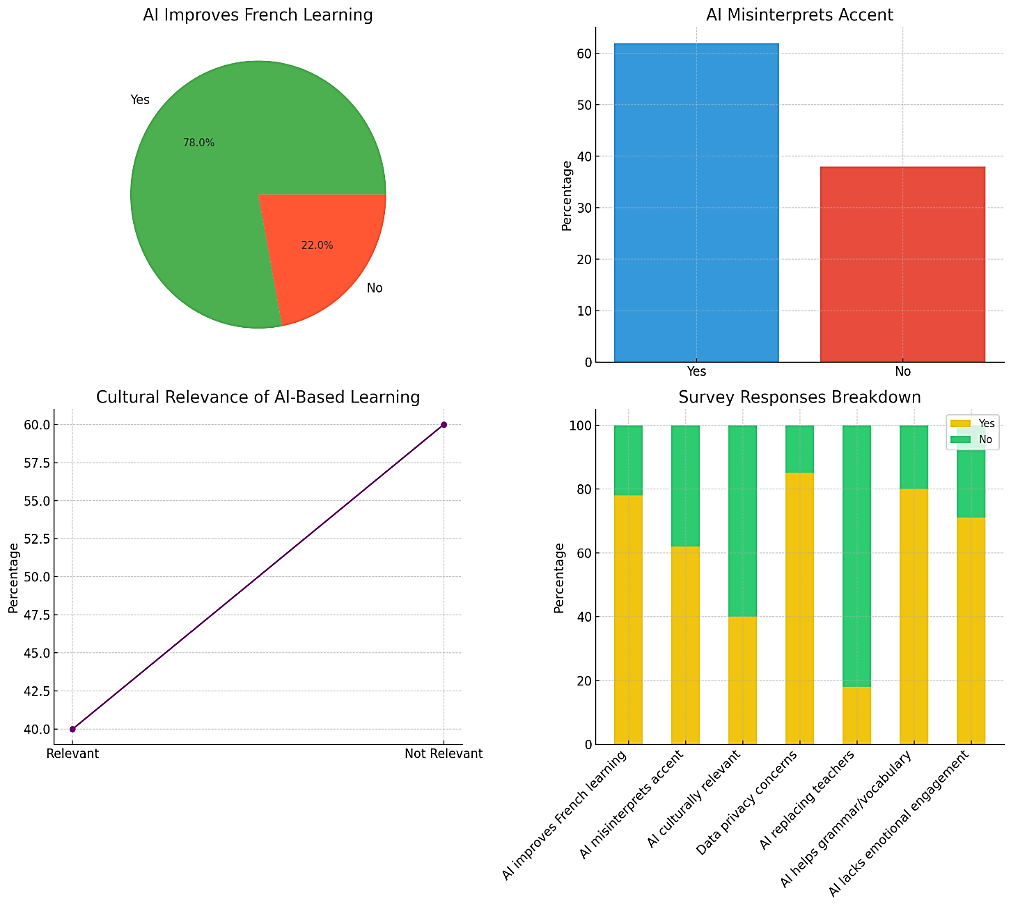
Interview participants : 10 AI experts and 5 experienced FFL educators. Data collection period : Conducted over four months (September ² December 2024). Table 1. The questions and key findings. Question Responses Do you think AI improves French language Yes: 78% / No: 22% Have you faced issues with AI - driven pronunciation tools misinterpreting your accent? Yes: 62% / No: 38% Do you believe AI - based learning is culturally relevant for Indian learners?
Yes: 40% / No: 60% Are you concerned about data privacy when using AI tools? Yes: 85% / No: 15% Do you think AI can replace human teachers in French language education? Yes: 18% / No: 82% Does AI - based learning help improve grammar and vocabulary? Yes: 80% / No: 20% Do you feel AI - driven learning lacks emotional engagement? Yes: 71% / No: 29% Chaubey | Metaverse . 1 ( 2 ) ( 202 4 ) 81 - 90 Fig. 1.
The finding of quantitative and qualitative survey . Data privacy concerns : The survey revealed that 85% of respondents are worried about data security. AI tools collect personal information, including voice recordings and learning behaviours, raising concerns about unauthorized data use. Algorithmic bias : AI pronunciation and grammar tools struggle with non - Western accents, with 62% of students facing misinterpretations. This bias can discourage learners and lead to inaccurate assessments.
Role of educators : 82% of teachers believe AI cannot replace human instruction, emphasizing the importance of emotional engagement and cultural immersion in FFL learning. Cultural limitations : AI - driven platforms focus on standardized French (Parisian dialect), neglecting regional variations. 60% of students find AI - based learning culturally irrelevant for Indian learners. Passive learning and engagement issues : AI excels at grammar correction and vocabulary building, with 80% agreeing it helps in these areas. However, 71% of students feel AI lacks emotional engagement, affecting motivation and interactive learning.
6.1 Recommendations
Based on the findings of the study, several recommendations can be made to address the ethical and pedagogical challenges of AI. These recommendations aim to optimize AI integration while ensuring ethical compliance, pedagogical effectiveness and inclusivi ty for Indian learners. Eth Strengthening data privacy regulations AI - EDVHG )UHQFK OHDUQLQJ SODWIRUPV PXVW FRPSO\ ZLWK VWULFW GDWD SULYDF\ ODZV HQVXULQJ WKDW VWXGHQWV· personal data, including speech recordings and learning patterns, are securely stored and not misused.
,QVWLWXWLRQV VKRXOG DGRSW WUDQVSDUHQW SROLFLHV UHJDUGLQJ $, GDWD FROOHFWLRQ LQ OLQH ZLWK ,QGLD·V HPHUJLQJ Personal Data Protection Bill. Users should have the right to opt out of data tracking without compromising their access to learning resources. Mitigating algorithmic bias AI developers should train models on diverse linguistic datasets, including Indian - accented French, to improve accuracy in pronunciation recognition.
Collaborative initiatives between Indian universities and AI researchers should work on developing localized AI models that accommodate regional variations in speech. AI - powered French learning platforms should allow human verification of assessments to correct any biases that AI - driven grading might introduce. AI ethics awareness for educators and students Educational institutions should introduce AI ethics awareness programs for both teachers and students to LQIRUPWKHPDERXW$,·VOLPLWDWLRQVELDVHVDQGHWKLFDOFRQVLGHUDWLRQV AI platforms should include ethical disclaimers stating that AI - generated assessments and recommendations should be used as learning aids, not final evaluations.
Blended learning: AI and human interaction AI should serve as a complementary tool rather than replacing human educators in French learning instruction. AI - driven automated assessments can handle routine tasks, but classroom interaction is essential for fostering critical thinking, creativity and cultural understanding in language Schools and universities should blend AI - driven personalized learning with live teacher - led sessions for better engagement.
Training teachers for AI - assisted education Teachers need professional development programs focused on AI - assisted pedagogy, ensuring they can effectively integrate AI tools into their lesson plans. The Indian government, under initiatives like NEP 2020, should facilitate AI training workshops for French teachers to enhance their digital literacy. Universities should introduce AI - Pedagogy Certification Courses to equip future educators with AI literacy skills.
Developing AI - customized learning materials for indian learners AI - based platforms should incorporate Indian cultural and linguistic contexts to make learning more relatable and engaging for Indian students. Textbooks and online French language resources should include AI - generated conversational exercises that reflect real - life situations relevant to Indian learners. Chaubey | Metaverse .
1 ( 2 ) ( 202 4 ) 81 - 90
7 Conclusion
The integration of AI in the teaching of French Language presents both opportunities and challenges, necessitating a balanced approach to ensure ethical compliance and pedagogical effectiveness. This study has examined the ethical concerns, including data privacy risks, algori thmic bias and the diminished role of human HGXFDWRUV DORQJVLGH SHGDJRJLFDO FKDOOHQJHV VXFK DV $,·V OLPLWDWLRQV LQ FXOWXUDO FRQWH[WXDOL]DWLRQ communication development and student engagement. One of the primary findings of this resea rch is that while AI - powered tools significantly enhance personalized learning, they remain insufficient in nurturing PHDQLQJIXOODQJXDJHDFTXLVLWLRQZLWKRXWKXPDQLQWHUYHQWLRQ7KHVWXG\KLJKOLJKWVWKDW$,·VUHOLDQFHRQYDVW datasets often fails to accomm odate linguistic diversity, particularly in the Indian context, where learners exhibit varied accents, cognitive learning patterns and cultural references. It concerns over student data security in AI - driven education demand the implementation of robust pr ivacy frameworks and ethical AI policies. Pedagogically, AI has proven to be a useful tool for pronunciation correction, automated assessment and adaptive learning, but it cannot replicate the social and cultural immersion required for language mastery.
Th e study also highlights that AI - based learning should not replace human instructors but rather serve as a complementary tool, enhancing traditional pedagogical approaches through blended learning models. This requires trained teachers to integrate AI effec tively while retaining the interactive and communicative aspects of language instruction. From an Indian perspective, the research reveals that AI adoption in French language education remains concentrated in urban settings with adequate technological infr astructure, while rural and semi - urban learners face significant barriers to access. The study calls for government support in making AI - driven language learning tools accessible and affordable across diverse socio - economic backgrounds. Based on these find ings, the study recommends a hybrid AI - KXPDQWHDFKLQJDSSURDFKWKDWEDODQFHV$,·VHIILFLHQF\ with the indispensable human element of language instruction. Ethical considerations, including transparent data policies and inclusive AI models that recognize di verse linguistic backgrounds, must be prioritized.
)XUWKHUPRUHFRQWLQXRXVUHVHDUFKDQGDVVHVVPHQWDUHHVVHQWLDOWRUHILQLQJ$,·VUROHLQODQJXDJHHGXFDWLRQ,Q conclusion, while AI holds immense potential in revolutionizing French language education, its effectiveness depends on responsible implementation, teacher preparedness and a culturally adaptive framework. Future research should explore AI - driven pedagogical models that integrate ethical safeguards and enhance the linguistic experience for learners in India and beyond.
Funding
This paper received no external funding.
Data Availability
The data used and analyzed during the current study are available from the corresponding author upon reasonable request.
Conflicts of Interest
The author declares no conflicts of interest regarding the publication of this paper.
Refe rences
[1] Jegede, O. O. (2024). Artificial intelligence and English language learning: Exploring the roles of AI - driven tools in personalizing learning and providing instant feedback. Universal library of languages and literatures , 1 (2), 6 ? 19. https://doi.org/10.70315/uloap.ullli.2024.0102002 [2] Kuddus, K. (2022). Artificial intelligence in language learning: Practices and prospects. In Advanced analytics and deep learning models (pp. 1 ?
17). Wiley Online Library. https://doi.org/10.1002/9781119792437.ch1 Eth [3] Odeleye, O. A. (2025). The role of AI in enhancing the teaching and learning of French language in colleges of education i n Nigeria. In Role of AI in enhancing teaching/learning, research and community service in higher education (pp. 155 ? 162). https://B2n.ir/hg5021 [4] Ismail, I. A., & Aloshi, J. M. (2025). Data privacy in AI - driven education: An in - depth exploration into the data privacy concerns and potential solutions. In AI applications and strategies in teacher education (pp. 223 ?
252). IGI Global. https://doi.org/ 10.4018/979 - 8 - 3693 - 5443 - 8.ch008 [5] Khan, W. N. (2024). Ethical challenges of AI in education: Balancing innovation with data privacy. Journal of AI integration in education , 1 (1), 1 ? 13. https://www.researchcorridor.org/index.php/jaiie/article/view/238 [6] Tan, L. Y., Hu, S., Yeo, D. J., & Cheong, K. H. (2025). Artificial - enabled adaptive learning platfo rms: A revi ew.
Computers and education: artificial intelligence , 100429. https://doi.org/10.1016/j.caeai.2025.100429 [7] Riaz, S. (2025). User perceptions of vocabulary learning features in Duolingo and Babbel : A comparative analysis of effectiveness and user satis faction. Qlantic journal of social sciences , 6 (1), 482 ? 495. https://doi.org/10.55737/qjss.vi - i.25345 [8] Nuryah, A. (2024). The comparison between lecturer and AI - ??????
pronunciation [Thesis]. https://repository.uinjkt.ac.id/dspace/handle/123456789/82085 [9] Korell, J. L., & Albrecht, P. (2025). Artificial intelligence in French and Spanish foreign language educa tion: A systematic review and future persp ectives. Language education and technology , 5 (1). https://www.langedutech.com/letjournal/index.php/let/article/view/90 [10] Dimitriadou, E., & Lanitis, A. (2023). A critical evaluation, challenges, and future perspectives of using artificial intelligence and emerging technologies in smart classrooms.
Smart learning environments , 10 (1), 12. https://doi.org/10.1186/s40561 - 023 - 00231 - 3 [11] Ali, M., Siddique, A., Aftab, A., Abid, M. K., & Fuzail, M. (2024). AI - powered cust omized learning paths: transforming data administration for students on digital platforms. Journal of computing & biomedical informatics , 6 (02), 195 ? 204. https://jcbi.org/index.php/Main/article/view/299 [12] Singh, P., & Absar, S. (2021). Comparative privacy legislat ion: Indian and european personal data protection legislation in the digital a ge.
Journal of legal studies , 3 , 78 ? 92. https://heinonline.org/HOL/LandingPage?handle=hein.journals/jrnatila19&div=38&id=&page= [13] Beliaeva, Z. (2023). ?????????????? [Thesis]. https://thesis.unipd.it/handle/20.500.12608/75494 [14] Azizov, D. (2023). Voice, accent, and identity in AI interpreting : Toward more inclusive language mod els.
Iconic research and engineering journals , 7 (6), 498 ? 506. https://B2n.ir/ej9187 [15] Selwyn, N. (2019). Should robots replace teachers?: AI and the future of education . John Wiley & Sons. https://www.wiley.com/en - se/Should+Robots+Replace+Teachers%3F%3A+AI+and+the+Future+of+Education - p - 9781509528967 [16] ?? ??? ?? ??? ?? ?? ?? ?? ???????? ¡? ? ?? ? ?? ? ?
psychological well - being in AI - assisted language instruction with/without teacher support in Malaysia. British educational research journal . https://doi.o rg/10. 1002/berj.4184 [17] Banerjee, N., & Rakshit, S. (2024). Enchantment of nce: Emerging advances in language developm ent. Brolly , 5 (3), 233 ? 251. https://journals.lapub.co.uk/index.php/brolly/article/view/2884 [18] Divekar, R. R. (2020).
AI enabled foreign language immersion: Technology and method to acquire foreign languages with AI in immersive virtual worlds . Rensselaer Polytechnic Institute . https://www.proquest.com/openview/a7007e1bb6eb7454d17f0c341dfc7d3c/1?pq - origsite=gscholar&cbl=44156 [19] Kaur, N., & Kaur, J . (2024). Innovating education through techno logy: A pathway to achieving the sustainable development goals in the context of national education policy 20 20.
Synergy: international journal of multidisciplinary studies , 1 (3), 28 ? 33. https://sijmds.com/index.php/pub/article/view/23
Figures